Tuesday, October 25, 2016

Global Plastic Pollution in the Ocean

If the ocean is a country, it would be the biggest country linking throughout every single corner of the globe. With the vast and large surface area, we categorise them based on their respective current flow of sea water - Mediterranean Sea, South Pacific, North Atlantic, North Pacific, Indian Ocean, South Atlantic, and Global Ocean. What has been found in these area, due to the lack of data available and cohesive measurement, the value and figures are not sufficient in accounting for the amount of pollution from plastic in the sea.

Over 5 trillions plastic has been discovered afloat which is equivalent to 250,000 tonnes in the our Ocean. If the world largest animal, a full fledged blue whale weighs about 181 tones, it would take 1381 whales to account for the amount of plastic we left floating around in the ocean. From the oceanographic evidence gathered, it points toward the southern hemisphere where there is a high level of concentrated plastic debris especially in gyres(areas with low wind and slow spiralling water). The test model made various different micro-plastic size from the lowest 0.33mm to macro-plastic 200mm. Despite the categorical plastic size, respective prefix of micro, macro and meso are limited to define plastic pollution. A range of micro-plastic (0.33mm to 5mm), meso-plastic (4.75mm without upper limit) and macro-plastic (upper limit of 200mm) such as plastic bottles(Eriksen et al., 2016).


In various factors of global dynamics has underestimated all of the above value. Ocean surface caused by wind is mixing and driving many debris down to the bottom of the ocean. The value has only accounted for what is on the surface.

Indian Ocean of Southern Hemisphere appears to have greater particle weight and counts in comparison to South Atlantic and South Pacific Ocean combine. These countries include Madagascar, Malaysia, Singapore, Indonesia, New Zealand, Australia, Paraguay, Brazil, Namibia, Uruguay, South Africa, Argentina, Chile, Botswana, Lesotho and Swaziland. The amount of these area is amounted to a 32.5% of the earth filled and carrying 80.9% of sea waters.


As you can see, the centre of the earth with the plastic particles limited from 0.33mm - 1.00 mm spread across the world with up to 100,000 quantities per pixel and particles of plastic of 1.01-4.75mm has a reach of 1,000,000 quantities per pixel in comparison to macro plastic of over 200mm around the world.

Image the above shows concentration of plastic particles discovery.

References:Eriksen, M., Lebreton, L., Carson, H., Thiel, M., Moore, C., Borerro, J., Galgani, F., Ryan, P. and Reisser, J. (2016). Plastic Pollution in the World's Oceans: More than 5 Trillion Plastic Pieces Weighing over 250,000 Tons Afloat at Sea.

Monday, October 24, 2016

Introduction of Seabin

The Seabin is a unique and sustainable ocean cleaning technology invented by two Australian surfer (Andrew Turton & Pete Ceglinski). The Seabin is an automated marina rubbish bin that catches everything from plastic bottle, paper, oil, fuels and detergent which built from recycled material.
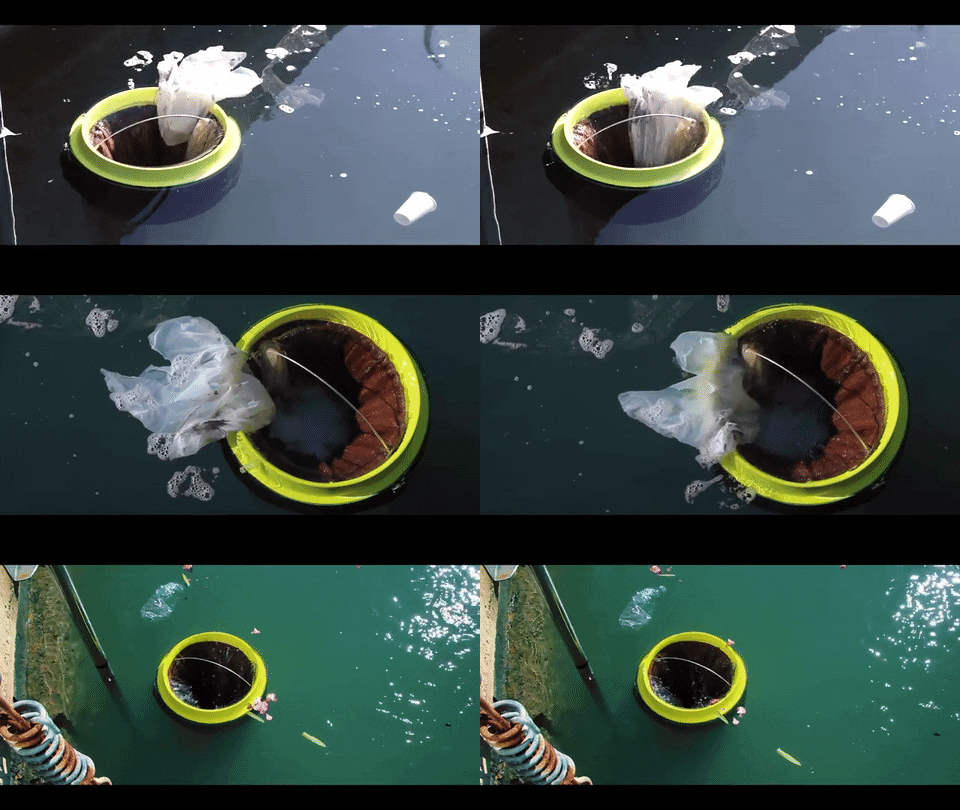
(GIF 1) source : giphy.com

The concept of Seabin is very simple yet very efficient and it has the potential to clean up the entire ocean. As can been seen on the GIF 1 above, Seabin is a basket which powered by a water pump, sucking all the floating trash into a removable mesh bag. 


Andrew Turton(left) & Pete Ceglinski(right) quit their jobs after being frustrated at the amount of rubbish floating in the ocean waters that they spent much of their childhood playing in.


Reference: Indiegogo. (2016). Cleaning the oceans one marina at a time. [online] Available at: https://www.indiegogo.com/projects/cleaning-the-oceans-one-marina-at-a-time#/ [Accessed 1 Oct. 2016].

Written by :LING HOW CHUEN

Sunday, October 23, 2016

How it work

How it work


SeaBin is a concept taken from Marine industry with the aid of attaching it to a terminal machine which has a concept of creating differential pressure between the seabin from the atmospherical pressure. The Terminal Machine is call PUMP that is powered by motor which require electricity to operate.

During the operation of the pump attach well below the bin and placing a filtration system which not limit to 50 microns depending on situations. The process of which the operation creating suction flow of liquid in this case sea water.

When the suction in process, the point at the opening of the seabin will occur vacuum process which draw water and the surrounding into the bin. Some may have install centrifugal pump which has the ability to further purify sea water from impurities. It is require to maintain constant monitoring process in case of clogging resulted from filtration which in return will destroy the pump by running dry process (over heating).


Thursday, October 20, 2016

Cleaning From Marine to Open Ccean


Rubbish collected by the Sea bin can harm marine life if allowed into the open ocean.
Mr Ceglinski said they will start cleaning up the ocean starting from ports, marinas and yacht, because these places has high human activity which is closely associated  with oil and fuel contamination. At the same time, Sea bin is more proficient than a marine laborer walking around with a scoop net.Hopefully this creation will help reduce or eliminate entirely the chances of marine life eating toxic waste or having these waste float out to sea where they can't decompose naturally.

Mr Talmage said this idea is useful in preventing harmful plastic waste from becoming a part of the marine food chain.This benefits the boarder environment not only for raising awareness for pollution, as they hope that these activities will help educate people who live close to the marinas, moreover, they believe that someday they can drive towards s cleaner environment for the people who rely on the ocean for a living.
Both of them have establish a research and development center  to develop production techniques in Majorca.

The cost is high when they desire to utilize a more sustainable and ecologically responsible way to build the sea bin.  Therefore they went to the biggest marine industry trade show in the world " METSTRADE" and found a few people who share a common interest in lending a hand in manufacturing and hopefully encourage governments and mariners from around the world to embrace and support this project(ABC News, 2016).

ABC News. (2015). 'Seabin' designed by Aussie surfers sick of ocean pollution. [online] Available at: http://www.abc.net.au/news/2015-12-20/seabin-designed-by-australian-surfers-to-start-cleaning-up-ocean/7044174 [Accessed 8 Oct. 2016].

Written by: Tan Pei Juen (Hisako)

Wednesday, October 19, 2016

Bins built using recycled ocean waste

Andrew Turton and his team have been perfecting the Sea bin at a Spanish workshop

The aim for this invention is to reduce the  pollution in the ocean and set to be made available in up to  17 countries next year, with a prototype undergoing final trails in luxury European marinas.Mr Ceglinski said there a large amount of interest from cities and corporate companies around the world who had seen a pilot project at La Grande-Motte in France. With the huge interest that had been generated, people are crawling hand over foot to have sea bin. 

This project had signed an agreement with one of the manufacturer based in France with factories in Australia,, United State and Europe to distribute the sea bin in around seventeen countries in the beginning of next year. The Australian company expect to sell around one thousand quantities of sea bin in the first year of production.

Mr Ceglinski and Mr Turton with a team of six staff in Majorca have accomplish the final design of the bin.In late September they can start to work on the final model and products once they have completed the test for strength, rigidity and flotation testing. 

"Each version we've done has been better, perfecting each one... We have a solar powered 24-volt pump coming next week which we are really excited about."
Bins built using recycled ocean waste
The Sea bin Project is using plastic collected from the ocean by New York-based environmental group Parley for the Oceans to construct the device. They have received twenty kilos of plastic and they need to get their structure engineers to test this to work out what percentage at which they can use to construct sea bin(ABC News, 2016). Marine scientist have also been engaged to devise an educational program and oversee results. There are some local schools that are interested and wants to interact with this project. It's now a prerequisite for marinas that want to be an ambassador for the project to partner with a local school or sport club.They are starting to take water samples to create base data for when they start to disperse the Sea bins into the water the following week. At that time they can see the changes in the environment."

ABC News. (2016). Surfers set to turn Seabin dream into sales reality. [online] Available at: http://www.abc.net.au/news/2016-07-28/seabin-project-nears-reality-for-wa-surfers-with-2017-sales-plan/7665270?pfmredir=sm [Accessed 8 Oct. 2016].

Written by: Tan Pei Juen (Hisako)

Tuesday, October 18, 2016

Cost to clean up: Traditional Method vs Seabin

What is the cost to cleaning up the ocean? It is difficult to answer.There are million tons of plastic is floating around the world’s blue ocean sea, the researcher put a price tag which are $13 billion a year on the environment damage. There are more than 20 million tons of plastic flow into the ocean every year, well 80 per cent of the garbage is on the shore and sea (Kirby, 2016). 

In North Pacific Ocean, they spend $122 million and $489 million in a year ($5,000-20,000 per day) Assume that a boat with an 18 ft. (5.5 m) beam and surveyed the area within 100 m off of each side of the ship. If the ship travelled at 11 knots (20 km/hour), and surveyed during daylight hours (approximately 10 hours a day), it would take 67 ships one year to cover that area! Well this is just an expanse for boat time only, it hasn’t included the labour cost and equipment (Response.restoration.noaa.gov, 2016).


Furthermore, the founder of Ocean Recovery Alliance said that they run the “Plastic Disclosure Project” in California, Washington and Oregon, the cost is approximately $13 billion, besides, the cost of removing the waste is around $500 million. (Kirby, 2016)
Therefore, the cost of cleaning up the ocean are tremendously high.
                                                      source:abovethelaw.com
However, if we use Seabin to clean up the ocean it works efficiency, because Seabin is an electronic vacuum garbage bin it can run 24/7 and simple to empty. The cost for the bin is just $3,825 (£2,500) each. The inventors are looking to raise $230,000 (£155,000) on Indiegogo to make their idea a reality (Griffiths, 2016).

Griffiths, S. (2016). The ocean VACUUM that sucks rubbish and oil from waterways: £2,500 'Seabins' trap floating debris found along coastlines. Mail Online. [online] Available at: http://www.dailymail.co.uk/sciencetech/article-3370235/The-ocean-VACUUM-sucks-rubbish-oil-waterways-2-500-Seabins-trap-floating-debris-coastlines.html [Accessed 2 Nov. 2016].
Kirby, D. (2016). Ocean Plastic Pollution Costs $13 Billion a Year, and Your Face Scrub Is Part of the Problem. [online] TakePart. Available at: http://www.takepart.com/article/2014/06/30/ocean-plastic-pollution-costs-13-billion-year-and-your-face-scrub-part-problem [Accessed 2 Nov. 2016]. 


Response.restoration.noaa.gov. (2016). How Much Would it Cost to Clean up the Pacific Garbage Patches? | response.restoration.noaa.gov. [online] Available at: http://response.restoration.noaa.gov/about/media/how-much-would-it-cost-clean-pacific-garbage-patches.html [Accessed 2 Nov. 2016]. 

Written By: Tan Pei Juen (Hisako)


Monday, October 17, 2016

The progress of seabin

Up till now, Ceglinski and Turton have a total of $267,000 in an Indiegogo campaign to make this product a reality and have also signed a contract with French company Poralu Marine, a docking equipment manufacturer who will take over manufacturing of seabin(Weiser, 2016). Prototypes currently being made and tested before being released to the consumer market, and the surfers who came up with this idea expects that seabin will be ready and released into the consumer market by the end of the year.
                                              source: colourbox.com

Reference:the Guardian. (2016). Brain wave: the surfers who made a trashcan for the ocean. [online] Available at: https://www.theguardian.com/sustainable-business/2016/mar/30/seabin-ocean-pollution-epa-marina-miami-garbage [Accessed 2 Nov. 2016].